Gambler Panel: The Russian Scam Network Behind Thousands of Fake Celebrity Casinos

Alertoscan Research Team
Threat-intelligence analysts
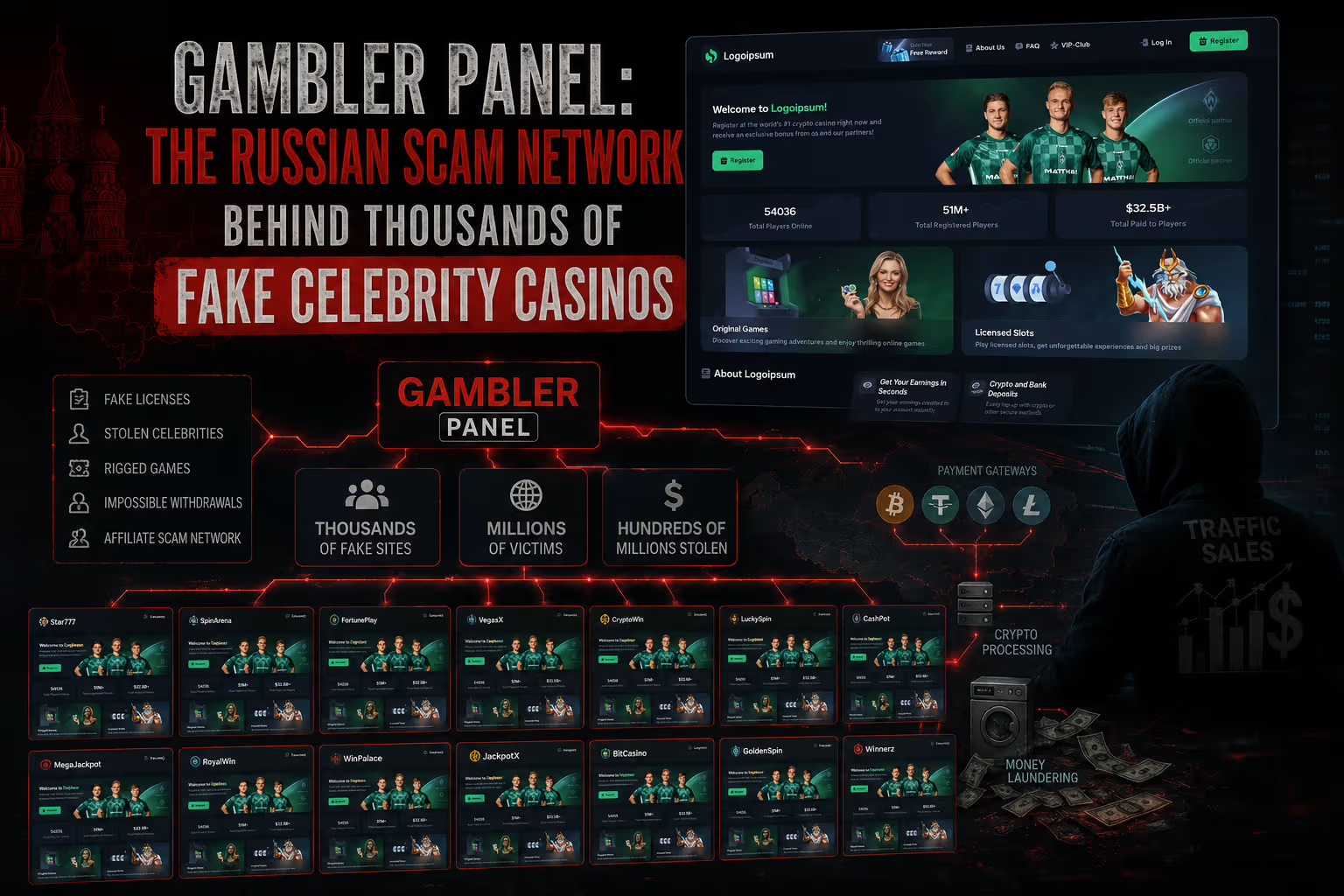
In July 2025, a 17-year-old Discord administrator who goes by the name Thereallo got fed up with spam. His investigation exposed a network of over 1,200 fake casino websites, all powered by a single Russian platform that openly calls itself "a soulless project that is made for profit." That number keeps growing, with dozens of new domains launching every day.
The operation goes by Gambler Panel, and it's a full-blown franchise, not just a scam site. A fraud-as-a-service infrastructure that gives criminals everything they need to steal cryptocurrency at scale: a custom-built fake casino engine, ready-made ad templates for Instagram and TikTok, scripts for handling victims in live chat, and a profit-sharing model paying affiliates up to 70% of stolen funds.
Victims don't stumble onto these sites randomly. They're lured by fabricated celebrity endorsements from MrBeast, Elon Musk, Drake, Cristiano Ronaldo, Lionel Messi, and Donald Trump. Deepfake videos, fake news articles, and hijacked social media accounts make these endorsements look real. These celebrities have no connection to these casinos, and their identities have been hijacked to defraud you.
What follows is the complete anatomy of how the scam works, who runs it and how it got exposed.
How the Scam Works
To understand why this scam works, you need to walk through it the way a victim would. What looks like a random online casino ad is actually a carefully engineered psychological funnel designed to exploit trust, trigger dopamine, and extract maximum value before the target realizes what's happening.
Stage 1: The Ad
The hook arrives through your feed, whether that's a Discord server, an Instagram story, a TikTok video, or a YouTube Short. The format varies, but the content follows a rigid formula that Thereallo documented during his investigation.
A screenshot appears to show a verified celebrity account on Twitter/X announcing a new crypto casino. A promo code promises instant free credits, and the urgency is manufactured:
- "Post will be deleted soon"
- "Only the fastest users"
- "Withdraw immediately"
The visual presentation is polished, with the celebrity's profile picture, verification badge, and writing style all looking authentic.
In some cases, scammers create entire fake news articles. One documented example featured a fabricated BBC story with a real journalist's byline promoting a site called GAMBWEX.COM.
Stage 2: The Landing
The website looks legitimate, and more than that, it looks premium. Sleek interface, intuitive navigation, polished games with smooth animations. Nothing feels cheap or suspicious, and that's entirely intentional.
According to Gambler Panel's own documentation, their platform underwent "a lot of audits, surveys of real people and test traffic floods" to create "something that has no doubts about the legitimacy and trustworthiness even for an inveterate gambling addict with many years of experience."
The site displays impressive statistics like thousands of players online and millions in total payouts, but these numbers are fabricated by bots and fake accounts to simulate activity.
Registration requires only an email with no KYC, so you're in within seconds.
Stage 3: The Bonus
You enter the promo code from the advertisement and your account balance instantly shows $2,500, sometimes up to $10,000 depending on the campaign.
The games are familiar formats popular in legitimate crypto casinos: Crash, Plinko, Dice, Slots, Mines, Tower, Coinflip. You start playing with your "free" credits and you win. Your balance grows, the Crash multiplier hits 5x just before you cash out, the Plinko ball lands on a high-value slot.
But here's the thing: you're not actually winning. According to the YouTuber "No Text To Speech", who documented the entire scam process, the games are rigged to let you win during this initial phase. The outcomes are scripted to build confidence and emotional investment before the trap closes.
Stage 4: The Block
Your balance looks healthy, so you decide to withdraw. You click the button, enter an amount, provide your crypto wallet address, and the request is rejected.
A message appears saying your account requires "verification" before withdrawals can be processed, framed as a standard security measure. The verification method is to make a deposit, typically $60 to $100 in cryptocurrency, supposedly to "confirm your wallet address" or "comply with anti-fraud protocols."
Stage 5: The Escalation
So you make the deposit, expecting to finally cash out. Instead, a new obstacle appears.
Maybe your account hasn't reached "VIP status" yet, requiring another deposit. Maybe there's an "anti-money laundering fee" that must be paid separately, or a "tax withholding" required before international transfers, or a "liquidity issue" that requires you to deposit more to "unlock" your funds.
Each payment generates a new requirement, and the justifications sound technical, almost plausible. The support chat responds quickly, within 1 to 7 minutes as mandated by Gambler Panel's internal guidelines, with professional and reassuring language.
According to documentation analyzed by "No Text To Speech," a victim who complies with every request can lose up to $4,410 before the requests stop. This figure was documented for a "Tier 3" country, meaning victims in higher-tier regions like the US or Western Europe likely face even larger extraction targets. They don't stop because the scammers are satisfied, but because the victim has been fully drained or finally refuses.
Stage 6: The Disappearance
When payments stop, so does the illusion of customer service. Support responses become delayed, then generic, then nonexistent. Your account may get locked, and the website itself may go offline only to reappear days later under a different domain with the same games, the same interface, and the same trap waiting for new victims.
For some victims, the exploitation doesn't end there. Shortly after being scammed, they receive messages from "recovery specialists" who claim they can retrieve lost funds for an upfront fee, which is often a secondary scam operated by the same network or by opportunists who purchase victim contact lists.
Recovering funds from these platforms is extremely difficult. While cryptocurrency transactions are recorded on public blockchains and can be traced by specialists, the operators hide behind layers of wallets and mixers, and most victims never report the crime to authorities.
Real Victims
The mechanics of the scam are clear enough on paper. But numbers and flowcharts don't capture what it actually feels like to be on the receiving end. Behind every "verification deposit" is a real person who believed they had found a way out of a difficult situation, only to be pushed deeper into it.
"I Almost Fell For It"
One user posted a warning on Trustpilot after nearly becoming a victim:
"I'm posting this as a warning because I almost fell for it and I know others already have. cusewin.cc has been circulating heavily on X, Reddit, and Telegram, pushed via screenshots that appear to show a verified celebrity X account promoting it, a '$2,500 instant bonus', a 'successful withdrawal' confirmation, a USDT balance supposedly received. After digging into it, this is not legit. It's a textbook crypto casino scam."
- Trustpilot review, cusewin.cc (January 2026)
They went on to break down exactly how the deception works: the green "Withdrawal Success" screen means nothing because there's no transaction hash, no blockchain explorer link, and no provable wallet transfer. It's just client-side UI designed to make victims believe their money is coming.
Why People Don't Report
Shame plays a significant role in the underreporting of these crimes. Victims often blame themselves for falling for something that, in retrospect, seems obvious. Many never report to authorities because they don't know who to contact, because cryptocurrency feels anonymous and untraceable, or because admitting they were scammed feels worse than absorbing the loss quietly.
This silence benefits the operators directly. Without victim reports, law enforcement struggles to grasp the scale of the problem. And without public testimonies, new victims have fewer warnings to encounter before clicking that first link.
Global Targeting with One Exception
These scams don't discriminate by geography. The Gambler Panel wiki explicitly states that affiliates can target "absolutely any type of traffic, regardless of origin" with one exception: citizens of CIS countries, meaning Russia and former Soviet republics, are off-limits.
This rule is standard practice among Russian cybercriminals and serves a purely practical purpose. By avoiding victims in their home region, operators reduce the risk of domestic law enforcement attention.
Russian authorities have historically shown limited interest in prosecuting cybercriminals who target foreign victims exclusively.
The Investigation
Here's the twist: the connection between hundreds of seemingly independent scam websites wasn't discovered by a government agency, a major cybersecurity firm, or a team of seasoned investigators. It was uncovered by a 17-year-old Discord server administrator who got tired of deleting spam.
The Trigger
The researcher, who publishes under the pseudonym Thereallo, operates multiple Discord communities. In mid-2025, these servers began experiencing a new kind of attack where compromised accounts would join, post 3-4 image links promoting crypto casinos, and immediately disappear. The pattern was mechanical, relentless, and identical across every instance.
"At first, I did what any admin would do. Ban the account, delete the message, move on. But they kept coming back. Different accounts, same scam, same 3-4 images. It was a fire I couldn't put out, and it started to piss me off."
- Thereallo
Rather than continue playing defense, he decided to investigate the source. He clicked one of the spam links and documented the entire experience: the registration process, the fake bonus, the rigged games, the blocked withdrawal, the "verification deposit" demand.
He understood immediately that this was advance-fee fraud dressed in casino aesthetics, but knowing how the scam worked wasn't enough. He wanted to understand how they were running it at scale.
The Fingerprint
Using browser developer tools, Thereallo began examining the network requests generated by the scam site. Most of the traffic was standard, a Next.js application proxied through Cloudflare, but one API call stood out. When the "Live Support" chat widget loaded, it sent a request to an unusual endpoint:
/api/mammoth/chat
Unlike Tidio, Intercom, or LiveChat, the third-party services legitimate websites typically use, this was a custom, self-hosted API. Thereallo had found something unique. He began checking other scam domains as they appeared in his servers, and every single one used the same endpoint.
"This was the fingerprint. The unique technical signature that connected all these seemingly separate websites."
- Thereallo
He codenamed the operation "Mammoth Scam", and soon discovered why that name was more fitting than he realized. An examination of Gambler Panel's wiki reveals that "мамонт" (mammoth) is the organization's internal slang term for victims.
In one section advising affiliates on engagement tactics, the wiki notes: "Иногда мамонт может на это повестись!" which translates to "Sometimes the mammoth might take the bait!"
The /api/mammoth/chat endpoint isn't just a technical fingerprint but the scammers' own terminology for their targets, embedded directly into their infrastructure.
The Unified Database
Thereallo attempted to register accounts on multiple scam domains, and after successfully creating an account on one site, he navigated to a completely different domain using the same IP address and tried to register again. The second site blocked him, but the error message didn't just say "registration failed." It specifically referenced the first site by name.
Final confirmation came from an unexpected source: his password manager. Thereallo uses 1Password to generate dummy credentials for investigations, and when he visited a scam domain he had never seen before and clicked on the email field, his password manager auto-filled the dummy email he had used on a previous site. The site immediately displayed an error: "An account with this email already exists."
"That was the final confirmation. All the scam sites share a single, unified user database."
- Thereallo
Suddenly, everything clicked into place. A central pool of agents handled support requests from all domains, with a dashboard showing which site each user came from. Agents refused to provide wallet addresses in chat because it was a network-wide security policy to force users through the automated funnel. New sites could launch instantly because they were simply new domain names pointing to the same backend infrastructure.
The Scale Revealed
Thereallo compiled his findings into a formal report with screenshots, technical documentation, and API fingerprints. Recognizing that this was beyond what he could address alone, he shared his research with cybersecurity journalist Brian Krebs, who validated the findings using his own resources. The /api/mammoth/chat fingerprint appeared on over 1,200 recently registered domains.
The picture was now clear: not a handful of scammers copying each other's homework, but a single, centrally-managed criminal platform operating at industrial scale. Thereallo's findings would soon lead to the exposure of Gambler Panel, the affiliate program powering the entire operation.
Inside Gambler Panel
So we know these thousand-plus scam sites share a single backend. The question is: who's behind it?
Gambler Panel. A Russian-language affiliate program that has industrialized cryptocurrency theft by turning scamming into a franchise opportunity.
"A Soulless Project Made for Profit"
Gambler Panel doesn't pretend to be anything other than what it is. Its website, hosted at gambler-panel.com, openly describes the operation as "a soulless project that is made for profit." This isn't dark web secrecy but brazen marketing.
Everything an aspiring scammer needs is provided: a fully functional fake casino platform, ready-made advertising materials, scripts for handling victims, and a generous commission structure.
In exchange, affiliates drive traffic to the scam sites through social media spam, compromised accounts, and paid advertisements. According to the program's own claims, Gambler Panel has recruited over 20,000 affiliates, and its Telegram channel maintains approximately 2,500 active members.
The Wiki: A Criminal Startup's Documentation
At the heart of the operation is a comprehensive wiki that reads like onboarding documentation for a legitimate tech startup, except the product is fraud. It covers the entire scam lifecycle, from attracting victims to extracting maximum value.
As Krebs on Security reported, it offers "affiliates advice on how best to entice visitors, keep them gambling, and extract maximum profits from each victim."
Thereallo's assessment was blunt:
"The wiki is kinda like a 'how to scam 101' for criminals written with the clarity you would expect from a legitimate company. It's clean, has step-by-step guides, and treats their scam platform like a real product. You could swap out the content, and it could be any documentation for startups."
- Thereallo
Targeting the Vulnerable: The Psychological Playbook
A section titled "Основные мотивы и байты для игры и регистрации" (Main motivations and hooks for playing and registration) explicitly instructs affiliates to exploit psychological vulnerabilities:
- "лудомания (игровая зависимость)": gambling addiction. "A person can easily bite on your creative and buy into good design to get that emotion they need, while charging deposits."
- "способ заработка": a way to earn money. Target people seeking quick income.
- "желание подзаработать 'лёгких' денег": the desire to earn "easy" money to spend on entertainment.
The wiki concludes this section with explicit instructions on manipulation:
"All these are weak points that need to be pressed in creatives and funnels, playing on people's feelings so they have no choice and an urgent desire appears to participate right now."
- Gambler Panel Wiki
The Fake Casino Engine
If there's one thing the operators aren't shy about, it's bragging. From the wiki:
"We have a completely self-written from scratch FAKE CASINO engine that has no competitors. Carefully thought-out casino design in every pixel, a lot of audits, surveys of real people and test traffic floods were conducted, which allowed us to create something that has no doubts about the legitimacy and trustworthiness even for an inveterate gambling addict with many years of experience."
- Gambler Panel Wiki
And that polish is precisely what makes it dangerous. Victims aren't encountering obviously fake websites with broken English and amateur graphics. They're interacting with a product that has been refined through user testing to maximize credibility. The scammers have applied legitimate product development practices to building a better trap.
The Affiliate Model
Gambler Panel operates on a revenue-sharing model common in legitimate affiliate marketing, except the "revenue" comes from theft.
| Element | Detail |
|---|---|
| Profit share | Up to 70% of stolen funds |
| Minimum per deposit | $10 guaranteed per "verification deposit" |
| Onboarding | Approval required via Telegram channel |
| Traffic sources | "Absolutely any type" accepted |
Notably, affiliates bear the risk of promotion while the platform handles infrastructure, payment processing, and victim management. As Thereallo observed:
"They've minimized their own risk, spreading the links on Discord, Facebook, YT Shorts, etc., and outsourced it to a hungry affiliate network, just like a franchise."
- Thereallo
Platform-Specific Attack Manuals
There are dedicated manuals for each social media platform:
| Platform | Manual Title |
|---|---|
| "Мануал по работе с Instagram" | |
| TikTok | "Мануал по работе в TikTok" + extended version |
| TikTok Live | "Мануал по стримам TikTok" |
| Threads | "Льём Threads" (3-part guide) |
| YouTube Shorts | "Льём YT Shorts" |
We're not talking about vague suggestions here. These are operational playbooks covering account setup, content creation, hashtag strategies, posting schedules, and evasion techniques. One tip advises affiliates to avoid commenting on posts from verified accounts because "the probability of catching a report is much higher."
Still Active: The Operation Evolves
As of January 2026, Gambler Panel's infrastructure remains fully operational. The wiki has migrated to a new domain (wiki.gambler-partners.is), hosted on GitBook, a legitimate documentation platform typically used by software companies. The documentation continues to be updated.
Recent additions include API documentation with WebSocket support, suggesting the platform continues adding technical capabilities. Team leaders ("ТСы") can now access tools to build and manage their own affiliate networks, including a ready-made Telegram bot for recruitment. Far from slowing down, the operation is professionalizing.
Training Scammers: The Live Chat Playbook
One section of the wiki, titled "Rules for working in Live chat," serves as a manual for the support agents who interact with victims trying to withdraw funds.
The rules are specific: respond within 1-7 minutes maximum, maintain a professional tone that's never confrontational, keep the user engaged and depositing as long as possible, and follow pre-written scripts for common withdrawal objections.
The support system combines human agents with AI chatbots. One commenter on Krebs' article noted that the support AI could be tricked into performing unrelated tasks:
"Their support AI happily wrote a react component for me."
- Comment on Krebs on Security
In other words: at least part of the "customer service" is handled by chatbots that can be tricked into going off-script.
The Marketing Machine
Gambler Panel's Telegram channel functions as both a coordination hub and a recruitment tool. It's filled with earnings screenshots showing affiliate dashboards with daily revenue figures, lifestyle content featuring photos of luxury cars supposedly purchased with scam profits, and images of women promoting the Gambler Panel brand.
The pitch is simple: join us and get rich. The irony: the same psychological manipulation used on victims (the promise of easy money) is used to recruit the people who victimize them.
A Scalable Criminal Enterprise
The amount of money stolen is staggering, but it's the business model that should concern security researchers most. Traditional scams require the scammer to handle everything: building websites, managing payments, responding to victims, distributing ads. It doesn't scale well.
Gambler Panel changed that equation entirely. Affiliates only need to drive traffic, and everything else is handled by the platform.
As Thereallo summarized:
"A centralized platform that can serve over 1,200 domains with a shared user base, IP tracking, and a custom API is not at all a trivial thing to build. It's a scalable system designed to be a resilient foundation for thousands of disposable scam sites."
- Thereallo
The sites are disposable while the platform is permanent. Each affiliate can create one or more domains with randomized names, meaning every scam domain you encounter is operated by a different affiliate, all connected to the same central Gambler Panel infrastructure. When a domain gets flagged or taken down, a new one can be deployed instantly with the same backend, same games, same database, and a fresh coat of paint.
Celebrity Deepfakes
We've covered how the platform works and who runs it. But none of it matters if victims don't click.
That's where the celebrities come in, or rather, their stolen identities.
Why MrBeast?
MrBeast (Jimmy Donaldson) is the most frequently exploited name in these campaigns, and the choice is strategic. He built his brand on giving things away, with videos featuring cash prizes, free cars, houses for strangers, and challenges where participants win life-changing money. When a MrBeast "casino" promises $2,500 in free credits, it doesn't feel implausible because it feels like something he might actually do.
Analyses of the fake advertisements show that the messaging deliberately echoes MrBeast's actual content style with excitement, urgency, and generosity. The fabricated tweets and videos are designed to feel like natural extensions of his brand.
MrBeast himself has no affiliation with any crypto casino and has publicly warned fans about these scams, but his warnings struggle to reach everyone who sees the fraudulent ads.
Targeting the Crypto Community
Beyond entertainment celebrities, Gambler Panel specifically targets cryptocurrency users by impersonating exchange executives like Changpeng Zhao (former CEO of Binance, the world's largest crypto exchange), Ben Zhou (CEO of Bybit, a top-3 derivatives exchange), and Star Xu (CEO of OKX, a major global exchange).
The targeting is calculated: someone who recognizes CZ's face is likely to hold cryptocurrency, which is exactly the payment method the scam requires. The fake endorsements create a false sense of industry legitimacy because if the Binance CEO appears to be involved, it must be real.
The Deepfake Arsenal
Static images of fake tweets were the first generation of this scam, but the operation has since evolved significantly. AI-generated videos now use deepfake technology to create footage showing celebrities appearing to endorse the casinos, featuring realistic facial movements, lip-syncing, and voice cloning that can fool casual viewers.
Scammers have also created entire fake news pages mimicking legitimate outlets. One documented example featured a fabricated BBC article, complete with the BBC's visual branding and layout, promoting a scam casino called GAMBWEX.COM.
The article even attributed quotes to a real BBC journalist named James Chater, who had no involvement whatsoever. Some campaigns feature fabricated interview clips showing celebrities discussing their "new casino venture" with recognizable news anchors, and names associated with CNN, Fox News, and other major networks have appeared in these manufactured clips.
The Discord Vector
Fake advertisements on social media are one distribution channel, but compromised Discord accounts are another. As Thereallo documented, scam messages flooded Discord servers through a coordinated campaign where the accounts posting these messages weren't random bots but real user accounts that had been hijacked.
The compromise chain worked through several stages. Users downloaded game cheats, mods, or cracked software containing malware, which then extracted Discord authentication tokens from the victim's browser.
Attackers used the stolen tokens to control accounts without needing passwords, and compromised accounts automatically posted scam images to servers they had joined.
What made this particularly insidious was that the spam didn't come from obvious bot accounts. It came from established users with server history. Friends received scam links from people they knew, and community members saw promotions from accounts that had been active for months or years. The victims of the Discord compromise became unwitting vectors for victimizing others.
The Template Library: Every Exploited Identity
Documentation from Gambler Panel's API reveals the full scope of celebrity exploitation. The platform offers pre-built templates for each fake endorsement, organized by category:
| Category | Names Exploited |
|---|---|
| YouTubers/Influencers | MrBeast, Logan Paul, Kylie Jenner, Selena Gomez |
| Tech/Crypto figures | Elon Musk, Bill Gates, Changpeng Zhao (Binance CEO), Ben Zhou (Bybit CEO), Star Xu (OKX CEO) |
| Footballers | Cristiano Ronaldo, Lionel Messi, Kylian Mbappé, Lamine Yamal |
| Combat sports | Ilia Topuria, Conor McGregor |
| Musicians | Drake, 50 Cent, Eminem, Snoop Dogg, Kanye West |
| Actors | Keanu Reeves, Angelina Jolie |
| Media personalities | Joe Rogan, various news anchors |
| Politicians | Donald Trump, Melania Trump |
None of these individuals have any connection to these scam operations. Their images, voices, and identities have been weaponized to defraud others.
The Drake exploitation is particularly calculated because Drake has a legitimate, widely-publicized partnership with Stake.com, a real crypto casino. By associating scam sites with Drake, the operators exploit confusion between their fake platforms and a genuine celebrity gambling endorsement.
The Trump Casino
Most striking is the existence of a dedicated "Donald Trump Casino" with over 30 template variants, including solo Trump templates in 5+ versions, Melania Trump templates in 4 versions, "Trump reaction" templates in 5 versions, and combinations featuring Snoop Dogg, Eminem, Kanye West, and 50 Cent.
The API also reveals templates for adult content including Playboy and Brazzers-branded themes along with various "18+" categories, indicating the operation targets multiple demographics simultaneously.
The Impossible Fight
For the celebrities being impersonated, this creates an unwinnable situation. MrBeast can post warnings, and has, but his legitimate content reaches only a fraction of the people exposed to scam ads. The scammers operate across thousands of domains, dozens of social platforms, and countless compromised accounts, so taking down one fake ad does nothing when hundreds more exist.
Legal action is theoretically possible but practically difficult because the operators are anonymous, likely based in Russia, and protected by jurisdictions that don't cooperate with Western law enforcement. The affiliate structure further diffuses responsibility, so even if one promoter is identified, thousands of others continue operating. The celebrities' fame has been weaponized against their own audiences.
The Scale
Individual scams cause individual harm. But Gambler Panel is an entire industry, not just another scam. Understanding how big it's gotten helps explain why traditional countermeasures have failed.
The Numbers
The figures uncovered by Thereallo and validated by security researchers paint a picture of industrial-scale fraud:
| Metric | Figure |
|---|---|
| Active domains | 1,200+ (and growing daily) |
| Registered affiliates | 20,000+ claimed |
| Active Telegram members | ~2,500 |
| Estimated theft (Q1 2024) | $2.5+ million |
The $2.5 million figure, reported by Archyde, represents only a three-month window from early 2024 and only the losses that could be tracked. The actual total is almost certainly higher because cryptocurrency transactions are pseudonymous, many victims never report their losses, and the operation has been running for considerably longer than one quarter.
For context, at the program's guaranteed minimum of $10 per "verification deposit," reaching $2.5 million would require 250,000 successful extractions. Even accounting for larger individual losses, the victim count is substantial.
Fraud-as-a-Service
The term "Fraud-as-a-Service" captures what makes this operation structurally different from traditional scams. In conventional fraud, criminals handle everything themselves: infrastructure, content, victim acquisition, payments, support. That doesn't scale. One person can only run so many scams at once.
Gambler Panel eliminates these constraints through specialization:
| Function | Who Handles It |
|---|---|
| Platform development | Core Gambler Panel team |
| Payment infrastructure | Core team |
| Support systems | Centralized agent pool + AI |
| User database | Centralized backend |
| Victim acquisition | Affiliates (outsourced) |
| Ad creation | Affiliates (with provided templates) |
| Risk of exposure | Primarily affiliates |
The core operators built the platform once, and affiliates do the dangerous, visible work of promoting it. When an affiliate gets banned from a social media platform or reported to authorities, the infrastructure remains untouched. New affiliates replace old ones, new domains replace flagged ones, and the machine keeps running.
Comparison to Pig Butchering
Security researchers have noted similarities between Gambler Panel operations and "pig butchering" scams, the romance and investment frauds that have caused billions in losses globally. Both share core mechanics like trust building before extraction, escalating demands, emotional manipulation, and irreversible cryptocurrency payments.
But there are key differences:
| Aspect | Pig Butchering | Gambler Panel |
|---|---|---|
| Investment per victim | High (weeks/months of relationship building) | Low (automated funnel) |
| Average loss per victim | Often $100,000+ | Typically $100-$5,000 |
| Volume | Lower (labor-intensive) | Higher (scalable) |
| Operator risk | Higher (direct interaction) | Lower (affiliate buffer) |
Think of it as the difference between a con artist running a long game and a factory running a production line. Lower returns per victim, but vastly higher volume and lower operational risk.
The Disposable Domain Strategy
One of the operation's most effective defenses is its approach to infrastructure. Each scam domain is disposable, so when a site accumulates too many complaints, gets flagged by security researchers, or appears on blocklists, it simply disappears. A new domain pointing to the exact same backend launches immediately.
For defenders, it's an unwinnable game of whack-a-mole. Picture the cycle: spinora.cc launches on day one and begins collecting victims. By day thirty, security researchers flag the domain. On day thirty-one, spinora.cc goes offline, and spinwin.cc launches with identical content. Rinse and repeat, indefinitely.
The user database persists across these transitions, so victims who registered on one domain remain tracked across all future domains. The "business" is continuous even as the storefronts rotate. Security firm Silent Push has attempted to track this proliferation by compiling lists of active domains associated with Gambler Panel, but the list is always incomplete and always outdated because new sites launch faster than they can be catalogued.
Why Takedowns Don't Work
Traditional approaches to combating online fraud assume that removing infrastructure disrupts operations. Against Gambler Panel, that assumption collapses.
Domain takedowns? Useless. New domains are trivial to deploy while the backend infrastructure, hosted separately and protected by layers of proxies, remains untouched. Affiliate bans? The pool is large and constantly refreshed, so removing one promoter from Instagram or TikTok changes nothing when thousands of others continue operating. Payment disruption? Cryptocurrency transactions don't route through traditional financial institutions that might flag suspicious activity.
Law enforcement faces jurisdictional challenges because the operators appear to be based in Russia, which does not extradite cybercriminals and shows limited interest in prosecuting those who target foreign victims. The operation was designed from the ground up to be resilient against exactly these countermeasures. Its distributed, affiliate-driven, crypto-native architecture represents a new generation of fraud infrastructure that traditional enforcement mechanisms weren't built to address.
Red Flags
Now that you know how this operation works, here's how to spot it before you become a victim. Every red flag below has been observed in documented Gambler Panel sites. Recognizing even one of them should stop you cold.
Visual Red Flags
The Game Selection
Gambler Panel sites offer a specific, consistent set of games: Crash (multiplier rises until random "crash"), Plinko (ball drops through pegs), Dice, Slots, Mines (minesweeper-style betting), Tower (climbing game with risk), and Coinflip. Legitimate casinos offer these games too, but they also offer much more. Scam sites have a narrow, identical catalog because they all run on the same backend engine.
Fake Activity Indicators
Scam casinos display fake "live" activity to simulate legitimacy. You'll see winner notifications like "John just won $5,000!" scrolling across the screen, online player counts in the thousands, chat windows showing excited "users" celebrating wins, and payout tickers claiming millions distributed. These are fabricated. The "users" are bots or scripted entries, and the numbers are implausibly high for unknown platforms with no market presence.
Too-Perfect Design
Ironically, scam sites often look too polished. Gambler Panel invested heavily in design because they know victims associate quality with legitimacy. Watch for slick, modern interfaces that feel like established brands, smooth animations and responsive interactions, professional branding that doesn't match any known company, and no visible flaws, which is itself suspicious for a new platform. Real startups have rough edges. Scam factories have templates refined through user testing.
Technical Red Flags
Domain Age
Check when the website was registered using our free scam URL checker, which displays WHOIS registration data alongside security analysis. Gambler Panel sites are disposable. Most are registered within the past 90 days, so a "casino" claiming years of operation on a domain registered last month is lying.
Impossible Licensing Claims
Many scam sites display licensing badges from multiple jurisdictions. A common combination is the Curacao Gaming Authority alongside the UK Gambling Commission. This is a tell because these licenses are mutually exclusive in practice. The UK Gambling Commission has strict requirements that conflict with Curacao's more permissive regime, and no legitimate operator holds both simultaneously. If a site claims multiple major licenses, verify each one directly on the regulator's website.
Generic or Missing Company Information
Look for warning signs like no physical address, no company registration number, no named executives or team members, claims like "1,500+ employees" with no LinkedIn presence, and "Established in 2017" with no internet archive history. Legitimate gambling companies are registered businesses with verifiable corporate structures. Scam platforms aren't.
No Pre-Existing Online Presence
Before depositing on any platform, search for "site name review," "site name scam," and "site name reddit." Gambler Panel sites are new and have no history before their launch. If a "major casino" has zero reviews, zero forum discussions, and zero mentions anywhere online, it didn't exist until recently regardless of what its "About Us" page claims.
Behavioral Red Flags
Unrealistic Bonus Offers
Legitimate casinos offer bonuses, but they do not offer $2,500 to $10,000 in free credits for simply creating an account. A real casino giving away thousands in playable credits to every signup would hemorrhage money. The only way such an offer makes sense is if the credits aren't real.
The Video Formula (From Their Own Playbook)
Gambler Panel's wiki describes exactly how their scam videos work:
"Your potential player sees a creative/video on social media, in which a famous personality or a real person enters a domain, promo code and receives funds on their balance, then plays games or slots, after which they get a big win and go to withdraw funds. After which they receive funds credited to their bank account or crypto wallet... After which, the security system will demand a deposit from them to receive the winnings to their personal account."
- Gambler Panel Wiki
This is the operators' own documentation, describing their method in their own words.
No Identity Verification at Signup
Regulated gambling platforms are required to verify user identities through a process called KYC (Know Your Customer), and this happens before you can play, not after. Scam casinos skip this step entirely during registration and only demand documentation when you try to withdraw, at which point the "verification" becomes a pretext for requesting deposits. If a casino lets you sign up and play with nothing but an email address, it's not operating under any legitimate regulatory framework.
Deposit Required to Withdraw
This is the definitive red flag and the mechanism at the heart of the entire scam. No legitimate platform requires you to deposit money in order to withdraw money. This concept has no basis in actual financial operations, and any site making this demand is attempting to steal from you. Common justifications include "verification deposit," "identity confirmation fee," "anti-money laundering requirement," "tax withholding," "VIP unlock fee," and "liquidity collateral." All of these are fabricated. If you encounter any of them, close the site immediately.
Escalating Obstacles
Even if you make an initial "verification" payment, new requirements will appear. First deposit for "verification," second deposit for "tax payment," third deposit because "VIP status required," fourth deposit for "additional collateral." The requests never end because each payment generates a new obstacle. The scam continues extracting money until the victim stops paying, not until some legitimate requirement is satisfied.
Quick Reference Checklist
Use this checklist when evaluating any unfamiliar online casino:
| Check | Red Flag |
|---|---|
| Bonus offer | $2,000+ free credits for signing up |
| Domain age | Registered within past 90 days |
| Licensing | Claims both UK and Curacao licenses |
| Online presence | No reviews, discussions, or history before recent weeks |
| KYC timing | No verification at signup, demanded only at withdrawal |
| Withdrawal process | Deposit required to withdraw |
| Game selection | Narrow catalog matching Crash/Plinko/Mines/Tower/Dice/Slots pattern |
| Activity indicators | Implausibly high player counts and win notifications |
| Company info | Vague details, unverifiable claims, no corporate presence |
| Celebrity endorsement | Promoted by famous figure without verification on their official channels |
If two or more red flags apply, do not deposit. If any payment is required to withdraw, it is a scam with no exceptions.
Closing
Thereallo got annoyed by spam. Now a criminal infrastructure spanning over a thousand domains, twenty thousand affiliates, and millions in stolen cryptocurrency is exposed.
Thereallo closed his published investigation with a principle that applies beyond this single case:
"What started as a simple annoyance with spam turned into a deep dive into an entire infrastructure. It proved that sometimes, the best way to protect your community isn't to just build higher walls. It's to figure out who's throwing rocks, and go take their rocks away."
- Thereallo
New domains still launch daily and new victims are targeted every hour, but the operation is no longer invisible. Its methods are documented, its fingerprints are known, and its affiliates know they're being watched.
If you've read this far, you understand the mechanics, you can spot the red flags, and you can warn others. The machine runs on ignorance, and every person who learns how it operates is one fewer potential victim.